Business & Technology
Your WhatsApp bill changes on October 1. Here’s the engineering audit to run first.
If you run the WhatsApp Business Platform, your WhatsApp API costs change on October 1, 2026. Two things that are free today stop being free: free-form service replies sent inside the open 24-hour customer service window, and utility templates sent in reply to a user inside that same window. There is no shortage of articles
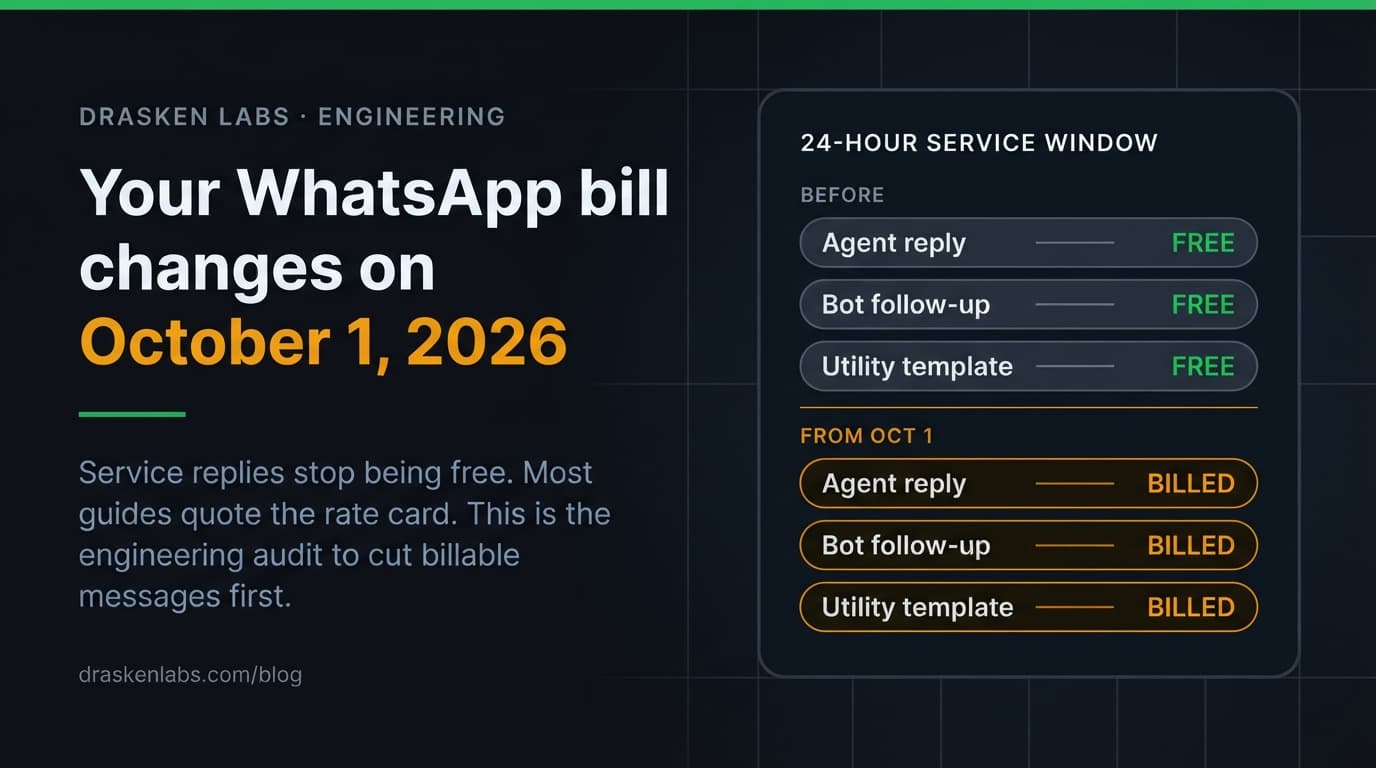
If you run the WhatsApp Business Platform, your WhatsApp API costs change on October 1, 2026. Two things that are free today stop being free: free-form service replies sent inside the open 24-hour customer service window, and utility templates sent in reply to a user inside that same window.
There is no shortage of articles explaining that. Almost all of them are written by messaging platforms, and almost all of them end at the rate card.
We build and run messaging infrastructure, so we look at this differently. Meta’s rate is fixed and non-negotiable. Your message count is not. That is the only variable you control, and nobody selling you per-message credits has an incentive to help you reduce it.
This post is the audit we run for clients: how to calculate your real exposure, the four architecture patterns that quietly inflate it, and what to instrument before the deadline so you find out in a dashboard rather than an invoice.
First, calculate your actual WhatsApp API costs
Before re-architecting anything, get a number. A lot of the alarm around this change is out of proportion to the money involved, and you should know which side you’re on before spending engineering time.
The India rate card puts utility and authentication messages at roughly ₹0.115 per message, with marketing templates far higher at around ₹0.86 after the January 2026 increase. Service messages are expected to land at the utility and authentication rate. Add 18% GST, and add whatever your provider charges on top.
Run the numbers on your own WhatsApp API costs before you spend engineering time:
A small support operation. 6,000 inbound conversations a month, averaging 4 agent replies each. That’s 24,000 service messages, or roughly ₹2,760 plus GST at Meta’s rate. Under ₹3,300 a month. This is not a project. Change nothing, absorb it, move on.
A support-heavy or bot-driven operation. 30,000 conversations a month, averaging 20 replies each because a chatbot handles first-line triage. That’s 600,000 service messages — around ₹69,000 plus GST at Meta’s rate, close to ₹10 lakh a year. And because service messages get no volume discount, this scales linearly forever. This one is worth a sprint.
The gap between those two numbers is not traffic volume. It’s messages per resolution. That is the metric this change actually taxes, and it is an engineering metric, not a pricing one.
Two things to check before you trust your estimate:
- Your provider’s markup, not just Meta’s rate. Meta’s per-message charge is one layer; your platform fee and per-message markup is another. For some businesses the markup is the larger number. If you can’t see the two separately on your invoice, that’s the first thing to fix. Our WA Console pricing page breaks these out deliberately for this reason.
- The 72-hour free entry point still exists. Conversations opened from a Click-to-WhatsApp ad or a Facebook or Instagram CTA keep their free entry window. If a meaningful share of your inbound comes from paid social, your exposure is smaller than a naive count suggests. Segment by entry point before you model.
Almost all avoidable WhatsApp API costs fall into four patterns.
The four patterns that make this expensive
Once you know the change matters for you, the work is reducing billable messages per resolved conversation — without degrading the experience. In practice, almost all of the waste we see falls into four patterns.
1. The multi-bubble reply
Chatbots and agent tooling frequently split one logical response across three or four message bubbles because it reads more naturally in a chat UI. Under the old model, inside an open window, this cost nothing. From October 1, a four-bubble reply costs four times a one-bubble reply.
Fix: compose at the response layer, not the send layer. Buffer outbound fragments for a short window — 400 to 800ms is usually enough — and flush them as a single message. This is a small change in your send adapter and it can remove 40 to 60% of outbound volume in bot-heavy flows on its own.
2. The acknowledgement message
“Got it, let me check that for you.” “One moment please.” “Thanks for confirming!” These exist because of latency, not because of user value. They were free filler; now they are line items.
Fix: most of them can be deleted outright. Where the latency is real, use WhatsApp’s typing indicator rather than a message, or fold the acknowledgement into the front of the substantive reply that follows.
3. The utility template that duplicates a service reply
A common flow: the customer asks about their order, an agent replies with the status in free-form text, and the system also fires an order-status utility template. Before October 1, both were free inside the window. After, you pay for both, for the same information.
Fix: this is a deduplication problem. Suppress automated utility sends when a human or bot has already answered on the same intent inside the same window. It requires your template dispatcher to be aware of conversation state, which most integrations built against the raw Cloud API are not.
4. The re-engagement nudge
“Are you still there?” and “Just following up on this” loops, particularly in abandoned-cart and lead-qualification flows, can send several messages into conversations that were never going to convert.
Fix: measure conversion by nudge index. In most funnels we’ve instrumented, the second follow-up converts at a fraction of the first and the third converts near zero. Cut the tail. This usually improves the numbers on both sides of the ledger.
What to instrument before September 30
The reason this change catches teams out is not that the rate is high. It’s that most integrations have no visibility into WhatsApp API costs at all, so the first signal is a monthly invoice that is 3x expectations with no way to attribute it.
You have roughly four weeks. Instrument this now, while service messages are still free, so you have a clean baseline to compare against.
Log these fields on every outbound message:
message_category— marketing, utility, authentication, service, or Meta Business Agentwindow_state— whether the 24-hour customer service window was open at send timeentry_point— organic, Click-to-WhatsApp ad, or Page CTA, to identify free-window conversationsconversation_id— a stable identifier so you can aggregate cost per conversationorigin— bot, human agent, or automation, so you know which system is spendingresolution_outcome— resolved, escalated, or abandoned
Then build three views:
- Messages per resolved conversation, broken down by flow. This is your primary cost driver and your primary optimisation target. Track it as a trend, not a snapshot.
- Cost attribution by origin. If your chatbot is responsible for 80% of outbound volume, that’s where the sprint goes.
- A monthly spend budget with alerting. Treat it exactly like an SLO — set a threshold, alert on burn rate, page someone when projected month-end spend exceeds it. This is standard practice for cloud spend and almost nobody applies it to messaging spend.
If you already run Prometheus and Grafana, this is a small amount of work — emit a counter per send, labelled by the dimensions above, and the dashboards fall out of it. If you don’t have that foundation, it’s the same instrumentation problem we solve in our observability practice, just pointed at a messaging bill instead of a service.
One caution on Meta Business Agent: if you use Meta’s built-in AI, it moved to token-based billing on August 1, 2026 at $2.00 per million tokens globally. That is a separate category with separate economics — don’t blend it into your per-message model, or your forecast will be wrong in both directions.
What not to do
Two failure modes are worth naming, because we’ve seen both.
Don’t degrade support to save ₹0.115. If a customer needs three messages to get a correct answer, send three messages. The optimisation target is redundant messages, not necessary ones. A support experience that gets worse to save five figures a year is a bad trade for almost any business with real customer lifetime value.
Don’t rebuild your stack on a rate that hasn’t been confirmed. Meta’s published pricing calendar committed to announcing the final country-level rates ahead of the October launch. Model your exposure as a range, not a point estimate, and confirm against Meta’s official pricing documentation and your provider before committing budget. The changes since 2024 have come roughly quarterly — build the assumption of ongoing revision into your model rather than treating any rate card as permanent.
The short version
- Calculate exposure first. For a lot of businesses this is noise, and the honest answer is to do nothing.
- If your messages-per-resolution is high, WhatsApp API costs scale linearly with no discount.
- Almost all the savings come from four patterns: multi-bubble replies, acknowledgement filler, duplicated utility sends, and re-engagement nudges.
- Instrument before September 30 so you have a pre-change baseline.
- Treat messaging spend the way you treat cloud spend: budgeted, attributed, and alerted on.
Running WhatsApp at volume and unsure what October looks like for you? Talk to a senior engineer — we’ll review your message flows and give you a real number, not a rate card. Or see how WA Console handles per-message cost attribution out of the box.
Frequently asked questions
What exactly changes on October 1, 2026?
Free-form service replies sent inside the open 24-hour customer service window become billable per message, and utility templates sent in response to a user inside that window lose the free status they held from July 2025. Service messages are priced at the same rate as utility and authentication templates in the same country, with no volume discounts.
Does this affect the free WhatsApp Business app?
No. The change applies to the WhatsApp Business Platform — the API — not the consumer WhatsApp app or the free WhatsApp Business app.
Are incoming customer messages charged?
No. Messages customers send to you do not create a Meta message charge. The change is on the outbound side.
Is the 72-hour free entry point window going away?
No. Conversations opened from a Click-to-WhatsApp ad or a Facebook or Instagram CTA keep their free entry point window.
What are WhatsApp API costs for an Indian business?
It depends on your message mix and volume. India’s utility and authentication rate has been around ₹0.115 per message, and service messages are expected to match it, plus 18% GST and your provider’s fees. Multiply by your monthly outbound message count inside the service window — not your conversation count — to get a realistic figure.
How is Meta Business Agent billed?
Separately. It moved to token-based billing on August 1, 2026, at $2.00 per million tokens globally. Third-party AI replies delivered through the API are treated as service messages instead, so which AI you use changes which pricing model applies.
Sources and further reading
- Pricing on the WhatsApp Business Platform — Meta for Developers
Written by
Suraj Kumar Aggarwal · Founder
Suraj Kumar Aggarwal is the founder of Drasken Labs, a Delhi NCR engineering firm building and operating custom software, cloud infrastructure, and observability for startups and scale-ups. He writes about the operational side of engineering — what systems cost, where they break, and how to see problems before customers do.