Software Engineering
Flutter vs React Native in 2026: Which Should You Build Your App With?
Flutter or React Native for your app in 2026? A practical comparison of performance, UI, tooling, hiring in India, code sharing with web and long-term maintenance, with a clear decision guide.
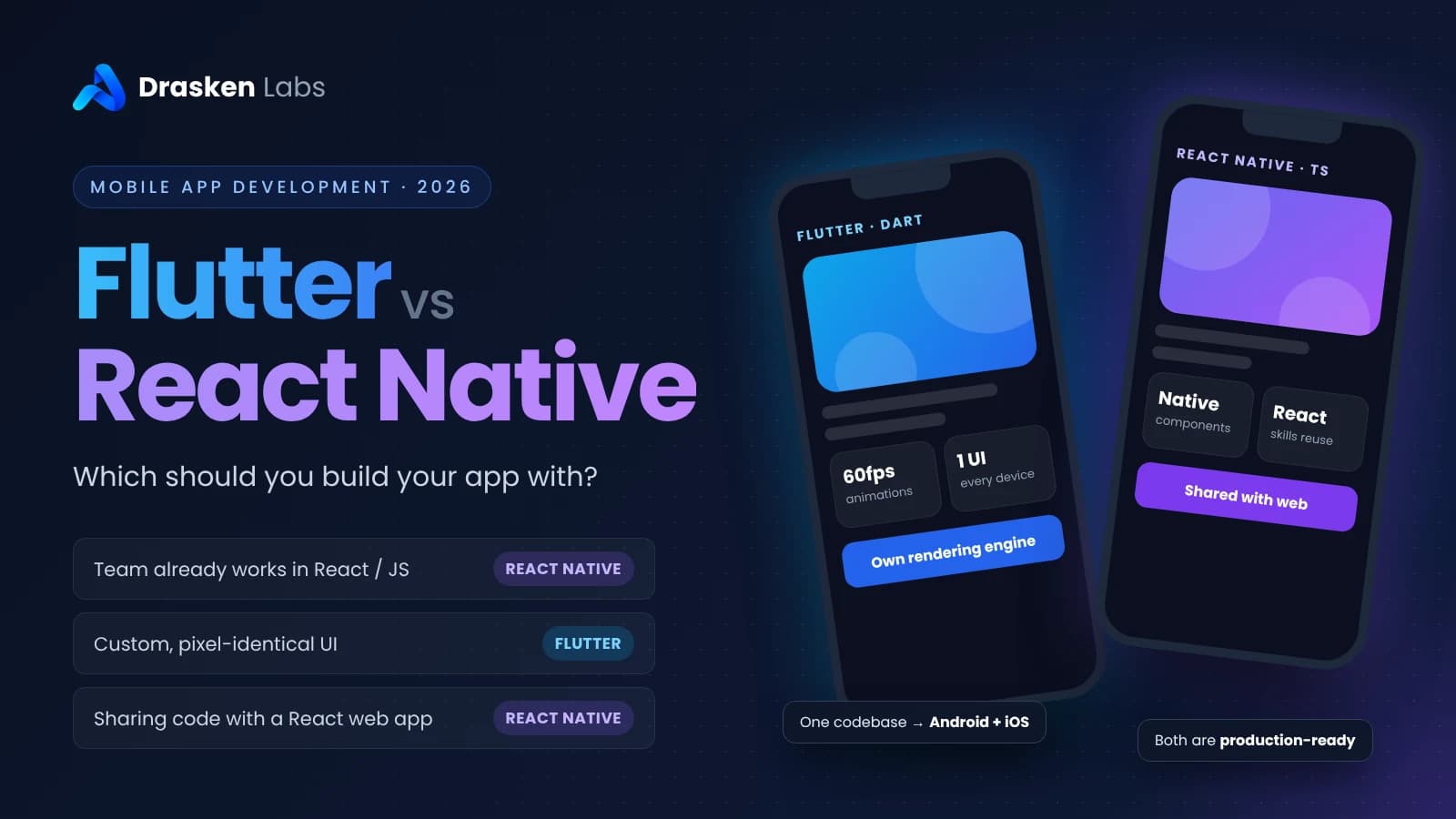
Flutter vs React Native is one of the first decisions you make when planning a cross-platform app development project. Both are mature, production-ready ways to build one app for Android and iOS from a single codebase. In 2026 the short answer is this: choose React Native if your team already works in JavaScript or React, or you have a React web app to share code with. Choose Flutter if you want a highly custom, pixel-identical interface on every device and have no existing web stack to reuse.
For most business apps, either framework will do the job well. The quality of the team building the app matters more than the framework it picks. This guide covers where the two genuinely differ, so you can make the choice for your product rather than by habit. If you are still at the budgeting stage, start with our breakdown of mobile app development cost in India.
| Flutter | React Native | |
|---|---|---|
| Backed by | Meta | |
| Language | Dart | JavaScript / TypeScript |
| How the UI is drawn | Flutter renders every pixel itself | Uses the platform’s real native components |
| Look across platforms | Identical on Android and iOS by default | Follows each platform’s native look |
| Performance | Very consistent, strong for heavy animation | Near-native for business apps since the New Architecture |
| Tooling | One official toolchain and DevTools | Expo is the recommended framework and build service |
| Hiring in India | Growing pool of Dart/Flutter developers | Large pool of JavaScript and React developers |
| Code sharing with web | Flutter web works for apps, weak for SEO sites | Shares logic and types with React web apps |
| Over-the-air updates | Through third-party tools | Built into Expo |
Flutter vs React Native: How Each Framework Works
The biggest technical difference explains most of the others.
Flutter draws its own interface
Flutter apps are written in Dart. Instead of using the buttons, lists and text fields provided by Android and iOS, Flutter draws the entire interface itself with its own rendering engine, Impeller. Every widget looks and behaves the same on every device because Flutter controls every pixel.
That gives designers complete freedom and removes a whole class of “looks different on Android” bugs. The trade-off is that Flutter has to recreate the look of native controls, and new platform UI conventions take time to be matched.
React Native uses native components
React Native apps are written in JavaScript or TypeScript using React. Your components map to the real native views on each platform, so a React Native list is an actual iOS or Android list.
Older React Native versions talked to native code through a “bridge” that could become a bottleneck. The New Architecture, now the default and the only path in current releases, replaced it with direct communication between JavaScript and native code. That change closed most of the performance gap people still associate with React Native.
Flutter vs React Native Performance
For typical business apps, such as booking, e-commerce, field service, dashboards and customer portals, users will not notice a performance difference between a well-built Flutter app and a well-built React Native app. In practice, the Flutter vs React Native performance question only matters at the edges.
Those edges look like this:
- Flutter is more predictable for animation-heavy interfaces, custom charts and complex transitions, because it renders everything through one engine.
- React Native performs well for standard interfaces and lists, and benefits automatically when Apple and Google improve their native components.
- Both can be made slow by poor engineering: oversized images, unnecessary re-renders, and heavy work on the main thread.
If your app is a game, uses augmented reality, processes video in real time or depends on intensive background work, consider fully native development instead of either framework.
UI and Design Consistency
This is often the deciding factor.
Choose Flutter when your brand needs an identical, custom-designed experience across devices, including custom components that look nothing like standard platform controls. Designers’ mock-ups translate directly, and QA checks one appearance rather than two.
Choose React Native when you want the app to feel native on each platform, with Android and iOS users each getting the controls and behaviours they are used to, or when you are extending a design system that already exists in React on the web.
Developer Experience and Tooling
Both frameworks offer hot reload, so developers see changes in seconds, and both have mature debugging tools.
- Flutter ships as one official package: the SDK, command-line tools, testing framework and DevTools all come from Google and are versioned together. There are fewer decisions to make.
- React Native is now built with Expo in most new projects. Expo adds a managed build service, easy access to device features, and over-the-air (OTA) updates that let you ship JavaScript fixes without waiting for app store review.
OTA updates are a practical advantage for React Native. Flutter can do something similar through third-party tools, but it is not part of the standard setup. Either way, OTA updates are only for fixes and small changes; new native features still go through store review.
Ecosystem and Access to Device Features
Both ecosystems cover the features business apps need: camera, maps, location, push notifications, biometrics, payments, file uploads and analytics. Payment gateways commonly used in India, such as Razorpay, provide SDKs for both.
- React Native draws on the npm ecosystem, which is huge but uneven. Some older libraries have not been updated for the New Architecture, so check maintenance status before depending on one.
- Flutter packages come from pub.dev, which is smaller but more consistent, with many core plugins maintained by the Flutter team itself.
When a feature has no package, both frameworks let developers write native Kotlin or Swift code and call it from the app. Budget for this if your app relies on unusual hardware or a vendor SDK that only ships for native platforms.
Hiring and Team Fit
For many businesses, this matters more than any technical point.
India has a very large pool of JavaScript and React developers. A team that already builds React web apps can become productive in React Native quickly, and the same engineers can work across web and mobile. Flutter has become very popular in India too, and experienced Flutter developers are readily available, but Dart is a separate skill that your web team is unlikely to have.
If you plan to keep development in-house, choose the framework your team can hire for and maintain. If you work with an external team, ask what they have shipped and maintained in production, not just what they list. Our comparison of freelancers and development companies covers what to check before handing over a project.
Sharing Code with Your Web Product
If you already have, or plan to have, a web application, this can settle the decision.
- React Native shares a language, types and often business logic with a React web app: API clients, validation rules, state management and utility code. Teams building a web platform and a mobile app together get the most benefit.
- Flutter web can run the same app in a browser, which works well for internal tools and app-like dashboards. It is a poor fit for marketing sites and content that needs to rank in search, which is better served by a proper website built for SEO.
Long-Term Maintenance
An app is maintained for years after launch, so upgrade effort matters.
- React Native upgrades were historically painful. Expo has made them far more manageable, and with the move to the New Architecture complete, the platform is more stable than it has been for years.
- Flutter upgrades are usually smoother because the whole toolchain is versioned together, although breaking changes in plugins still happen.
- Both are backed by large companies that use them in their own products, and both have large production users worldwide. Neither is at meaningful risk of disappearing within the life of a typical business app.
Whichever you choose, set up automated builds, crash reporting and regular dependency updates from the start. Apps that skip upgrades for two years end up needing a costly catch-up project. Crash and performance monitoring are part of good observability practice for the backend too.
Flutter vs React Native for Startups and Growing Businesses
If you are a founder or a business owner rather than a developer, the Flutter vs React Native question is really a question about speed, risk and who will look after the app in three years. A few practical points matter more than benchmark charts.
Getting to a first version. Both frameworks let a small team ship an MVP to Android and iOS in the same time it would take to build one native app. The fastest choice is the one your team or vendor has already shipped in production, because they already know the build, release and app store steps that slow first projects down.
Owning the code later. Whoever builds version one rarely maintains it forever. React Native is easier to hand over to an in-house team that already works in React, and the same developers can support your website and dashboards. Flutter code is very consistent between projects, so a new Flutter developer can usually find their way around a well-structured codebase quickly.
Reducing risk. Neither framework is going away. Flutter is backed by Google, React Native by Meta, and both power large, well-known apps. The bigger risk is an app built without tests, documentation or a release process, whichever framework it uses.
Before you decide, ask these questions of your team or development partner:
- Which framework have you shipped and maintained in production, and can we see those apps?
- Do we have a React web app, design system or team that we want to reuse?
- How custom is our design, and how much animation does the product need?
- How will we release urgent fixes, and do we need over-the-air updates?
- Who will maintain the app after launch, and can we hire for that framework?
Clear answers to these usually settle the React Native vs Flutter choice in one meeting. If you want a second opinion, our mobile app development team can review your requirements and recommend an approach before you commit to a build.
Does the Framework Change the Cost?
Not much. Build costs for a comparable app are similar in Flutter and React Native, because both let one team deliver Android and iOS from one codebase. That is what saves money compared with building two native apps. The larger cost differences come from scope, backend work, design and the team you hire, as we cover in our app development cost guide.
Where framework choice does affect cost is reuse. A company with an existing React web app and team will usually spend less with React Native. A company starting from nothing with a design-led product may move faster with Flutter.
Flutter vs React Native: Which Should You Choose?
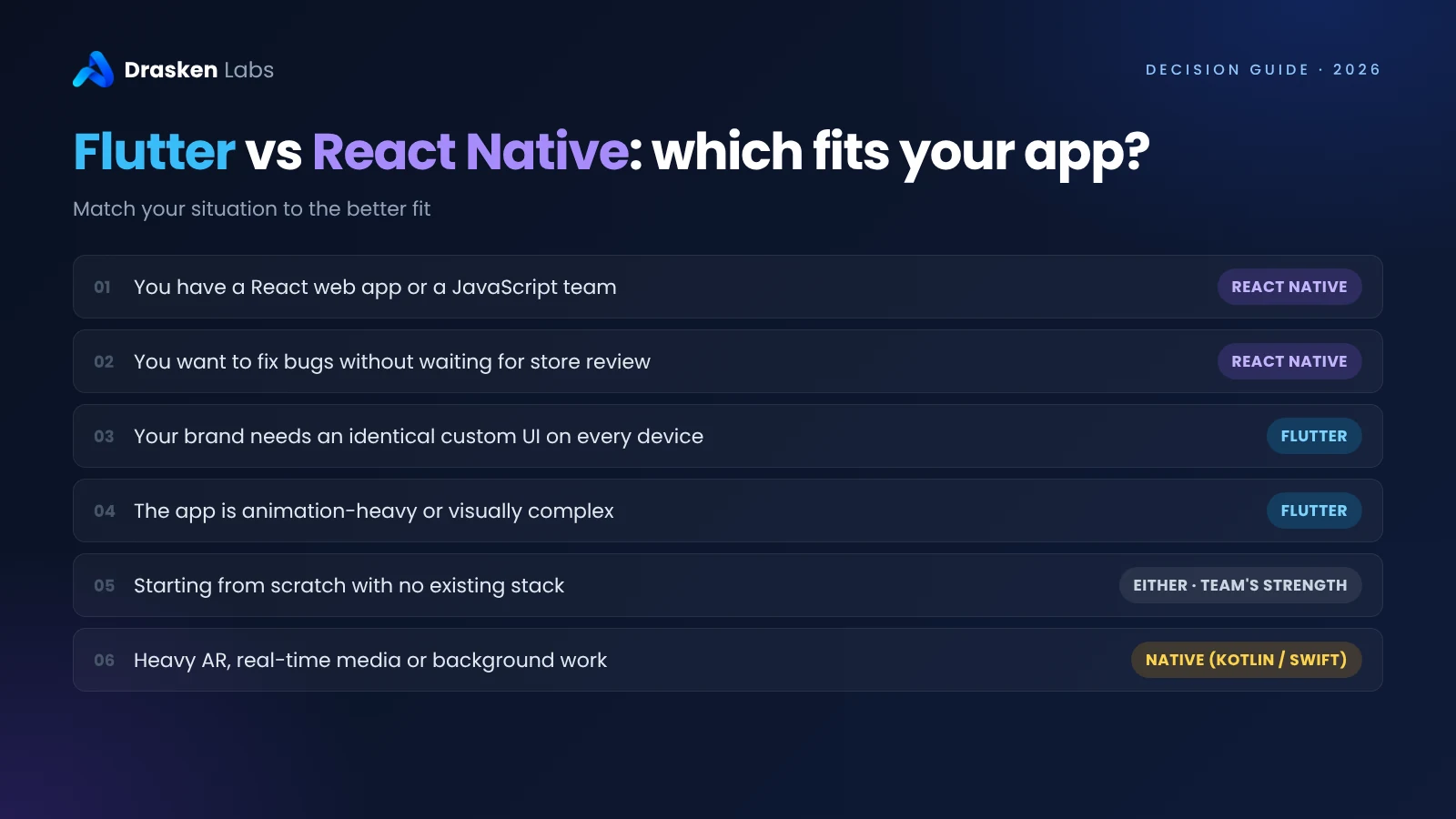
| Your situation | Better fit |
|---|---|
| You have a React web app or a JavaScript team | React Native |
| You want to fix bugs quickly without waiting for store review | React Native |
| Your brand needs an identical custom UI on every device | Flutter |
| The app is animation-heavy or visually complex | Flutter |
| You also need an internal web dashboard from the same code | Flutter (or React Native with a React web app) |
| You are starting from scratch with no existing stack | Either; choose based on your team or vendor’s strongest experience |
| The app depends heavily on AR, real-time media or intensive background work | Native (Kotlin and Swift) |
When to Choose Neither
Cross-platform is the right default for most business apps, but not all of them:
- Fully native (Kotlin for Android, Swift for iOS) when the product is built around deep platform features, demanding performance or the newest OS capabilities on day one.
- A progressive web app (PWA) when users don’t need to find you in an app store and the browser can do everything the app needs.
- Kotlin Multiplatform when you want native interfaces on each platform but shared business logic underneath, typically for teams already strong in Kotlin.
Final Thoughts
In the Flutter vs React Native debate, both are safe choices in 2026. React Native wins when you can reuse JavaScript skills, React code or a web team. Flutter wins when a custom, consistent interface is central to the product and you are not tied to an existing stack.
Decide based on your team, your existing systems and your product’s design needs, and then invest in the things that matter more than the framework: a clear scope, a solid backend, testing, and a plan for maintenance.
Whichever side of the Flutter vs React Native choice you land on, budget for the work that comes after launch: OS updates every year, framework upgrades, dependency checks, crash monitoring and small improvements based on what users actually do. A well-maintained app in either framework will serve your business far better than a neglected one built with the “right” tool.
Not sure which framework fits your app?
We build with both Flutter and React Native, and we recommend native or web when those fit better. Tell us about your product and the Drasken Labs team can help you choose the approach and scope the build. See our mobile app development services.
Frequently asked questions
Is Flutter or React Native better in 2026?
Neither is better for every app. React Native is usually the better choice when you have a JavaScript or React team or a React web app to share code with. Flutter is usually better when you need a highly custom, identical interface on Android and iOS and have no existing web stack.
Is Flutter faster than React Native?
For most business apps, users will not notice a difference. Flutter is more predictable for animation-heavy and visually complex interfaces, while React Native’s New Architecture has closed most of the older performance gap for standard apps.
Which is easier to hire for in India, Flutter or React Native?
React Native, in most cases, because India has a very large pool of JavaScript and React developers who can move into React Native quickly. Experienced Flutter developers are also widely available, but Dart is a separate skill.
Does Flutter or React Native cost less to build an app?
Build costs are similar for a comparable app because both deliver Android and iOS from one codebase. React Native can cost less if you can reuse an existing React web codebase or team.
Can I use the same code for my website?
With React Native, you can share business logic and types with a React web app. Flutter can run the same app on the web, which suits internal tools and dashboards, but it is not a good fit for marketing websites that need to rank in search engines.
When should I build a native app instead?
Choose native Kotlin and Swift development when your app depends on deep platform features, augmented reality, real-time media processing, intensive background work or the newest OS features as soon as they are released.
Written by
Aarav Mehta
Aarav Mehta writes for the Drasken Labs blog on cloud infrastructure, Kubernetes, observability, and practical engineering decisions for growing businesses. Articles are reviewed by the Drasken Labs engineering team before publishing.