Web Development
Freelancer vs Web Development Company in 2026: Which Should You Hire?
Freelancer vs web development company is a common decision for businesses planning a new website. A freelancer can be a practical choice for a small, clearly defined project, while a web development company can provide broader expertise, structured development, and ongoing support for more complex requirements. Short answer: hire a freelancer when the job is
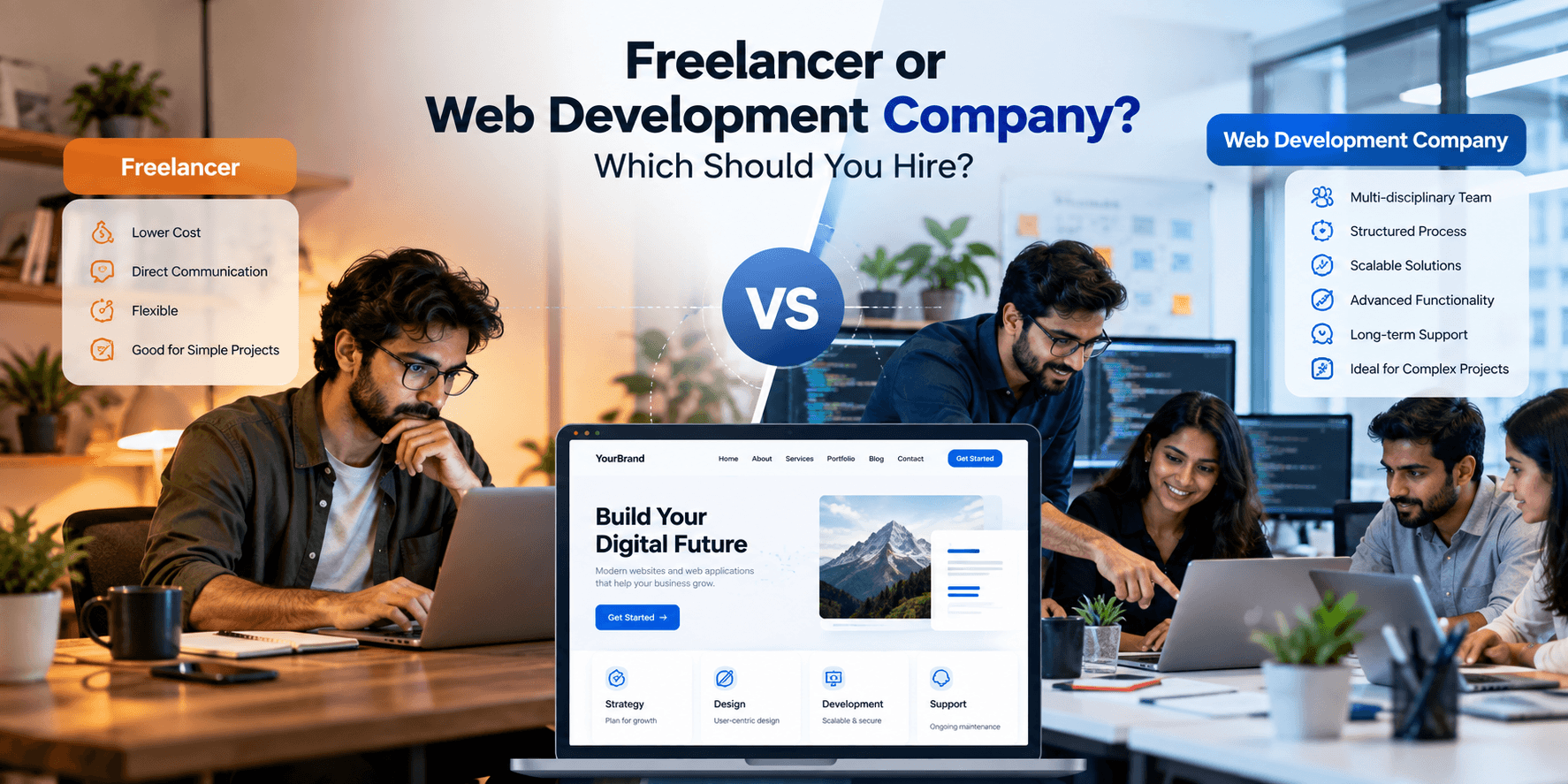
Freelancer vs web development company is a common decision for businesses planning a new website. A freelancer can be a practical choice for a small, clearly defined project, while a web development company can provide broader expertise, structured development, and ongoing support for more complex requirements.
Short answer: hire a freelancer when the job is small, clearly defined, and you have the time to manage it yourself. Hire a web development company when the website has to generate business, connect to other systems, or keep working reliably long after launch.
Most bad website projects are not caused by bad developers. They are caused by a mismatch: a company hired to build a single landing page, or one freelancer asked to deliver what is really a software project with design, integrations, SEO, hosting and security all riding on one person.
We are a website development company, so read this with that in mind. We have also told plenty of prospective clients that a good freelancer was the better fit for them. This guide is the same reasoning we use in those conversations.
The real difference is not price
The obvious difference is cost: freelancers usually quote less. But the thing you are actually buying is different in each case.
With a freelancer, you are buying one person’s skills and one person’s availability. If that person is a strong designer, you get strong design. If they are weaker at backend work, security or SEO, the project inherits those gaps. And if they get sick, take on a bigger client, or simply stop replying, the project stops.
With a web development company, you are buying a team and a process. A professional website touches several distinct skills: UX and visual design, frontend development, backend and integrations, technical SEO, testing, hosting and deployment, and project management. A company can put a different specialist on each, review each other’s work, and keep going if someone is unavailable.
So the real question is not “who is cheaper?” It is: how many of those skills does your project actually need, and who will cover the ones a single person can’t?
When a freelancer is the right choice
A good freelancer can be an excellent choice, and often the most sensible one. Freelancers tend to work best when:
- The scope is small and fixed. A landing page, a portfolio, a small brochure website on a proven template, or a specific fix on an existing site.
- You can manage the project yourself. You will write the brief, provide the content, review the work and make the decisions.
- The budget is tight and a simple online presence is genuinely all the business needs right now.
- You need one specific skill, such as a WordPress theme tweak, a Figma design, or speeding up an existing page.
- You have found a proven specialist with live work you can inspect and references you can call.
Advantages of hiring a freelancer
- Lower cost, because there is little or no company overhead.
- Direct communication with the person doing the work.
- Fast start on small jobs, with no lengthy discovery phase.
- Flexibility on process, timing and small changes.
Disadvantages of hiring a freelancer
- Single point of failure. Illness, holidays, a bigger client or a career change can pause or end your project.
- Limited skill coverage. Few individuals are equally strong at design, development, SEO, security and hosting.
- You become the project manager. Planning, chasing and quality checking fall on you.
- Weaker accountability. Agreements are often informal, and enforcing them across cities or countries is hard.
- Thin post-launch support. Maintenance is usually best effort, fitted around other clients.
When a web development company is the right choice
A company earns its higher price when the website is part of how the business makes money. Choose a company when:
- The website is a lead-generation or sales channel, and its performance affects revenue.
- It needs integrations with a CRM, payment gateway, booking system, ERP, WhatsApp or internal APIs.
- SEO matters from day one, which means site architecture, not just meta tags added at the end.
- It handles data or logins, such as customer accounts, dashboards, portals or payments.
- You need it maintained and extended for years, not delivered and left alone.
- You don’t have time to manage developers and want one accountable party.
Once a website starts handling business logic (accounts, payments, workflows, data) it stops being a web design job and becomes a custom software development project. That is where the gap between one person and a team becomes very visible.
Advantages of hiring a web development company
- Multiple specialists: design, frontend, backend, QA, DevOps and project management.
- A defined process with scoping, milestones, testing and handover.
- Continuity: the project doesn’t stop if one person is unavailable.
- Formal contracts, tax invoices and a registered entity you can hold accountable.
- Structured support after launch, including maintenance, hosting and monitoring.
- Capacity to grow with you, from website to portal to app.
Disadvantages of hiring a web development company
- Higher cost, since you are paying for the team, process and overhead.
- Slower to start, because good companies scope before they build.
- Less flexible for tiny changes, which may go through a change-request process.
- Uneven quality across the market. Some agencies sell senior expertise and hand the work to juniors or subcontracted freelancers.
Freelancer vs web development company: side-by-side
| Factor | Freelancer | Web development company |
|---|---|---|
| Upfront cost | Usually lower | Usually higher |
| Speed to start | Often immediate | Scoping and planning first |
| Skill coverage | One person’s strengths | Design, development, QA and DevOps together |
| Project management | Mostly on you | Dedicated lead or project manager |
| Quality assurance | Self-tested | Separate review and testing |
| Availability risk | High: one person | Low: team continuity |
| Accountability | Often informal agreements | Contracts, invoices, registered business |
| Security practices | Depends on the individual | Should be defined (ask to see them) |
| Post-launch support | Best effort | Maintenance plans and response times |
| Growing the project | Hard to add capacity | Can add people and skills |
| Best for | Small, fixed, low-risk jobs | Business-critical sites and web apps |
The hidden costs nobody quotes you
The invoice is only part of what a website costs. (For typical budgets by website type, see our guide on how much a professional business website costs in 2026.) The costs that don’t appear on a quote are often the ones that decide whether the cheaper option really was cheaper.
Hidden costs of the freelancer route
- Your time. Every hour you spend writing briefs, chasing updates and testing pages is an hour not spent running the business.
- Rework. A site that looks right but loads slowly, breaks on mobile or can’t be indexed properly often has to be partly rebuilt.
- Handover pain. When a freelancer moves on, the next developer has to reverse-engineer undocumented code, plugins and server setup.
- Ownership gaps. Domains, hosting and analytics accounts registered in the freelancer’s name can be very hard to recover.
Hidden costs of the company route
- Change requests. Anything outside the agreed scope is usually billed separately. Agree how changes are priced before you sign.
- Over-engineering. Some companies sell complex solutions to simple problems. A five-page site does not need a custom platform.
- Lock-in. Proprietary builders or hosting you can’t move away from make every future change more expensive.
Which should you choose for your project?
| What you are building | Usually the better fit |
|---|---|
| Single landing page or campaign page | Freelancer |
| Small brochure site on a proven template | Freelancer or small studio |
| Lead-generation business website with CMS, SEO and analytics | Company, or a senior freelancer with a proven track record |
| E-commerce store with payments, inventory and shipping | Company |
| Customer portal, SaaS or web application | Company or engineering team |
| Website plus a mobile app sharing one backend | Company |
| Ongoing product development over years | Company or dedicated team |
A useful test: if the website went down for three days, what would it cost you? If the honest answer is “not much,” a freelancer is probably fine. If the answer involves lost leads, failed payments or customers who can’t log in, you need a team that can respond.
The middle options
It isn’t always a binary choice:
- Small studios of two to five people often combine freelancer pricing with some of a company’s continuity.
- Start with a freelancer, move up later. This works well if you insist on clean, documented code and keep every account in your own name from the start.
- Split the work. A company handles the build, hosting and integrations. A freelancer or your own team handles routine content updates in the CMS.
- Company for the platform, freelancer for campaigns. The core site stays stable while campaign pages are produced quickly and cheaply.
Red flags to watch for
When hiring a freelancer
- No portfolio of live websites you can open and test on your phone.
- Wants to register your domain or hosting in their own name.
- No written scope, timeline or payment milestones.
- A price far below every other quote, with no explanation.
- Can’t explain how they will handle SEO, security or backups.
When hiring a web development company
- The salesperson can’t answer basic technical questions, and you never meet an engineer before signing.
- They won’t tell you who will actually work on your project.
- Every project is squeezed into the same template package.
- The change-request policy is vague.
- No case studies or references you can verify.
Questions to ask before you hire anyone
Whether you choose a freelancer or a company, ask these before signing:
- Who will actually do the work? Named people, not “our team.”
- Will the domain, hosting, analytics and CMS accounts be in my name? The answer should be yes.
- Do I receive the source code and design files? Get it in writing.
- How do you test before launch? Look for mobile, browser, speed, form and security checks.
- How is SEO handled during the build? Site structure, page speed and indexability, not just meta tags. Google’s own SEO Starter Guide is a good baseline to compare against.
- Is the site accessible? Ask whether they design against WCAG guidelines.
- What happens if you are unavailable for two weeks? The answer tells you a lot about continuity.
- What does support cost after launch, and how quickly do you respond when the site is down?
- How are changes priced once the project is under way?
How Drasken Labs approaches this
Drasken Labs is an engineering-led development company. We scope before we quote, and if a project is small enough that a good freelancer would serve you better, we say so.
When a company is the right fit, the same team handles the whole lifecycle: design and development, integrations, hosting and DevOps, and monitoring after launch. You own your code, your domain and your accounts from day one. Our website development service covers business sites, CMS builds and e-commerce, and larger projects move into custom software development when the requirements call for it.
You can see how this works in practice in our work with GatimaanPayments and the TheMMK Studio website, or browse all of our projects.
Final thoughts
Neither option is better in general. A freelancer is the efficient choice for small, well-defined work you can manage yourself. A web development company is the safer choice when the website is a business system that has to perform, integrate and keep running.
Decide what the website needs to do, estimate what it would cost you if it failed, and hire accordingly.
Not sure which your project needs?
Tell us what you are building. We will give you a straight answer on scope, even if that answer is “hire a freelancer.”
Sources and further reading
- SEO Starter Guide, Google Search Central
- Web Vitals, web.dev
- OWASP Top 10, OWASP Foundation
- WCAG Overview, W3C Web Accessibility Initiative
Frequently asked questions
Is it cheaper to hire a freelancer or a web development company?
A freelancer is usually cheaper upfront because there is less overhead. The total cost can end up higher if the project needs rework, runs late or has to be handed to a new developer. For small, fixed-scope work a freelancer is usually the more economical option. For business-critical websites, the lower risk of a company often makes it cheaper over the life of the site.
Is a freelancer good enough for a small business website?
Often, yes. If you need a simple brochure website, the freelancer has live work you can check, and you keep the domain and hosting in your own name, a freelancer can deliver a good result. Consider a company once the website needs integrations, e-commerce, customer logins or ongoing development.
What are the risks of hiring a freelance web developer?
The main risks are availability (one person is a single point of failure), gaps in skills such as security or SEO, limited testing, informal agreements that are hard to enforce, and handover problems if the freelancer moves on. Written scopes, milestone payments and keeping every account in your name reduce most of them.
How do I make sure I own my website?
Register the domain, hosting, analytics and CMS accounts in your own name, and add the developer as a user rather than the owner. Your contract should state that you receive the source code, design files and database on final payment.
Can I start with a freelancer and move to a company later?
Yes, and many businesses do. It goes smoothly when the original site uses mainstream technology, the code is documented and every account is in your name. Undocumented custom code or accounts held by the freelancer make the move slower and more expensive.
Should I hire a web development company in India?
Indian development companies serve clients worldwide and can offer strong value. Judge any company, wherever it is based, on the same things: who does the work, how the project is managed and tested, who owns the code, how communication across time zones works, and what support looks like after launch.
Written by
Suraj Kumar Aggarwal · Founder
Suraj Kumar Aggarwal is the founder of Drasken Labs, a Delhi NCR engineering firm building and operating custom software, cloud infrastructure, and observability for startups and scale-ups. He writes about the operational side of engineering — what systems cost, where they break, and how to see problems before customers do.